Skip to content

The Future of Teaching in Canada: How Digital Classrooms Are Reshaping Learning Outcomes.

Canada’s education system is undergoing a major transformation driven by digital learning tools, hybrid classrooms, and AI-assisted teaching platforms. Schools across provinces are increasingly adopting technology to improve access, engagement, and performance.

However, this shift is not without challenges. While urban schools enjoy advanced infrastructure, rural and remote areas still struggle with connectivity and access to devices. Despite this, the future of Canadian education is clearly digital.

Teachers are now expected to blend traditional methods with digital tools like Google Classroom, AI grading systems, and interactive learning apps.

The result? A more flexible, personalized learning experience for students—but also a new demand for teacher training and digital literacy.

The Day AI Stopped Being Scary and Started Feeling Like Magic in Our Classrooms..

Last year AI felt distant. This year it walked into classrooms and started helping like a cheerful assistant.

Adaptive platforms now tweak lessons in real time, agentic tools manage big projects, and smart systems spot when a student needs a gentle nudge or a bigger challenge.

Meet Mia, who turned her math dread into excitement once her AI tutor started using stories and visuals that clicked for her. Her teacher, freed from hours of manual adjustments, could focus on cheering everyone on. Parents are thrilled to understand their kids’ learning styles better and join the adventure.

Teachers are reclaiming evenings and weekends. Students get patient, round-the-clock support that builds real confidence. These 2026 inventions make education more personal, accessible, and—dare we say—fun.

On Smart Teacher Online we’ve seen the smiles grow as families discover tools that spark creativity instead of replacing it. The message is clear: AI isn’t here to take over education. It’s here to amplify the best parts—the curiosity, the breakthroughs, the human connections.

Ready to turn your classroom or kitchen table into a place where learning feels like an exciting story? The future is already here, and it’s pretty wonderful.

Here’s How Claude Became the Super-Smart Classroom Sidekick Everyone’s Talking About.

Imagine never forgetting a single detail from the whole school year.

That’s Claude in 2026. With its massive memory and clever new tricks like ‘Dreaming’ agents that actually learn and improve, this AI has become the ultimate classroom sidekick.

Teachers are reclaiming evenings by generating differentiated lessons, fun activities, and personalized feedback in minutes. Students get 24/7 patient tutoring that adapts to how they learn best. Parents love being able to jump in and support homework without feeling lost.
From analyzing student drawings to building entire project plans, Claude turns overwhelming tasks into exciting possibilities.

And the best part? It’s built to be helpful and safe, keeping the human spark at the center of education.
At Smart Teacher Online, we’re thrilled to see families and educators using these tools to make learning more joyful and effective. Whether you’re a busy teacher, a curious student, or a supportive parent, Claude feels like that reliable friend who always has your back—and a few brilliant ideas up its sleeve.

Ready to meet your new favorite learning companion?

Raising Emotionally Intelligent Children in the Digital Age.

Ten-year-old Nneka came home in tears after friends laughed at her photo in a group chat.
Instead of anger, her mother sat with her: “Let’s breathe. How does this make you feel?”
That moment opened the door to emotional intelligence — the superpower every child needs in the digital age.
From naming feelings and practicing empathy online to managing reactions and building self-worth beyond likes, here’s how families can raise emotionally smart kids.
Technology connects us, but emotional intelligence helps us connect with care.
Read the full guide: Raising Emotionally Intelligent Children in the Digital Age.

Online Privacy 101 for Parents and Kids.

Nine-year-old Ada proudly posted a beach family photo — until her mom noticed their house number, school name, and exact location were clearly visible.
That moment sparked an important family conversation about online privacy.
From strong passwords and privacy settings to the “Stop, Think, Ask” rule — here’s a simple, story-filled guide every parent and child needs.
Online privacy isn’t about fear. It’s about giving kids the superpower to enjoy technology safely.
Read “Online Privacy 101 for Parents and Kids” and start the conversation today.

Giving Knowledge, Gaining Safety: A Mother’s Quiet Strength on International Women’s Day.

Every March 8, the world celebrates women’s resilience, brilliance, and unbreakable spirit.

At Smart Teacher, this day feels deeply personal. The most inspiring women we know aren’t always in headlines—they’re in cozy homes across Alberta, Canada: Black mothers, aunts, grandmothers, and teachers quietly teaching their children how to stay safe online. In giving this knowledge, they gain something profound: peace of mind, stronger families, and a legacy of empowerment that lasts.
Meet Aisha, a teacher in Edmonton.
Her family traces back to the early 1900s, when African American pioneers fled the Jim Crow South for freedom in Alberta communities like Amber Valley and Keystone.

Today, she raises her 12-year-old daughter, Maya, in a quiet neighborhood where snow dusts the rooftops. A few years ago, Maya came home shaken. A classmate had shared how an online “friend” asked for details—school name, after-school spots, family habits. What seemed like friendly chat turned unsettling. Aisha recognized the warning signs instantly.
That evening, with snow falling softly outside, Aisha and Maya sat at the kitchen table with hot chocolate steaming between them. Aisha made a promise: fear wouldn’t win.

She would turn anxiety into strength.
They started small. After homework, they opened the laptop together. Aisha told stories of trailblazing Black women—from the mathematicians in NASA’s Hidden Figures who calculated paths to the stars, to wartime codebreakers who protected nations in silence, to today’s Black women leading cybersecurity teams who defend digital spaces so children can learn and play without fear.

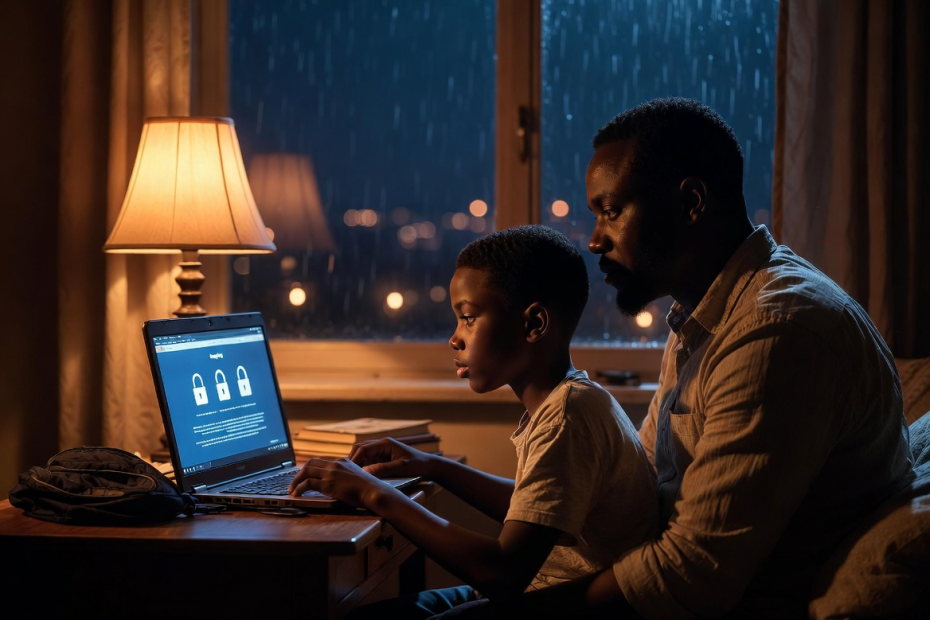
She taught practical lessons patiently: spotting phishing emails, creating strong passwords, managing privacy settings, and knowing that not every online “friend” is safe.
“Knowledge is the one thing no one can ever take from you,” Aisha would say, her voice calm and warm. “And right now, that knowledge keeps you safe where you learn, connect, and dream.”
Over time, the lessons took root. Maya didn’t just learn to protect herself—she began guiding others.

She reminded classmates to check suspicious links, helped her grandparents set up two-factor authentication, and spoke up when something felt wrong online. One small act of giving had sparked a gentle ripple.
This is the heart of #GiveToGain—the true spirit of International Women’s Day.

When mothers invest time, wisdom, and courage in teaching digital safety, everyone benefits: families gain security, communities grow more resilient, and girls like Maya step forward with confidence to lead in tech, innovation, and life.
To every Black woman in Alberta shaping the next generation—you are the true guardians of this digital era.

Your quiet reminders, late-night privacy checks, and loving explanations are powerful acts of love that reach far beyond your home.
On this International Women’s Day, we honor you with heartfelt gratitude. When you give knowledge, you gain empowered children. When you give courage, you gain a safer world for all.

Thank you for being the quiet revolution.
Happy International Women’s Day.
Let’s keep giving. Let’s keep gaining. Together.

Found this excerpt moving? Join us on Instagram and TikTok @smartteacheronline for more inspiring stories, family-friendly tips, and content that empowers you to raise confident digital natives. Subscribe today—let’s build safer online spaces side by side! 💙
What safety lesson did a woman in your life teach you? Share in the comments—we read every one.

#IWD2026 #GiveToGain #SmartTeacherOnline #BlackWomenInTech #AlbertaFamilies #DigitalSafety

How To Balance Screentime and Online Safety as a Smart Parent.

Parenting in today’s world means dealing with screens everywhere. At Smart Teacher Online, we focus on cybersecurity and edtech to help families stay safe. Screen time is how long we stare at phones, tablets, or computers. It’s fun for kids to play games or watch shows, but too much can be a problem. Eyes get sore, sleep gets short, and online risks pop up.

Smart parents balance fun with safety. Start with rules: Limit screen time to 1-2 hours a day for fun stuff. Use built-in timers on devices. This helps kids learn self-control.

Cybersecurity is key. Parental controls act like guards. They block unsafe websites and limit apps. Teach kids about dangers: Strangers online might ask for personal info. That’s called grooming – avoid it! Phishing is fake emails or messages tricking you into giving passwords. Use simple analogies: “It’s like a stranger offering candy – say no!”

Balance screens with offline activities. Play sports, read books, or cook together. This builds strong bodies and happy minds.

Parents, lead by example. Put devices away during meals. Family screen time can be good, like educational videos on animals or math.

In edtech, screens help learning. Apps teach coding or languages safely. But update software to fight viruses – bad programs that harm devices.

Strong passwords protect accounts: Use “P@ssw0rdFun!” instead of “1234.”

Involve kids in decisions. Ask, “What rules should we have?” This teaches responsibility.

Screen time affects health. Too much leads to less exercise, poor sleep, or feeling sad. Cybersecurity prevents bigger issues, like identity theft.

Tips for parents:

Monitor apps: Know what kids download.
Use family sharing: See locations and usage.
Educate on privacy: Don’t share photos with strangers.
For kids: Screens are tools, not toys all day. Tell parents if something online scares you.

At Smart Teacher, we believe safe screen time builds smart families. Try these tips today!

Could Canada Be the Next Country to Ban Social Media for Kids?

Social media has become a normal part of childhood for many families, but governments around the world are beginning to ask whether children are being exposed too early and at too great a cost. In Canada, this question is now at the center of a growing policy debate, as the federal government considers a possible ban on social media for children under the age of 14.

Canadian Culture Minister Marc Miller has confirmed that such a ban is being explored as part of broader online harm legislation. The move comes amid rising concern about how social media affects children’s mental health, safety, and development. From cyberbullying and online harassment to exposure to inappropriate content and addictive design features, parents and educators have long raised alarms about the risks children face online.

Canada is not alone in this conversation. Australia recently became the first country in the world to ban children under 16 from using social media platforms. That decision has sparked global discussion, with governments watching closely to see whether the policy will be effective in protecting young users. Canadian lawmakers are now examining similar approaches as they reconsider how best to safeguard children in digital spaces.

Parliament has spent several years studying online harms. Lawmakers have held multiple hearings focused on how social media platforms target young users and how easily children can be drawn into harmful online experiences. Since 2021, two versions of online safety legislation have been introduced but failed to pass. With increasing public concern and international examples to reference, the pressure to act is growing.

Technology companies, however, are pushing back against the idea of an outright ban. Many argue that enforcing age limits online is difficult, as current systems for age verification are often unreliable. Companies like Meta have suggested shifting responsibility to app stores, where Google and Apple could verify ages and require parental consent before allowing children to download social media apps.

For parents, this ongoing debate highlights an important reality. Regardless of whether a ban becomes law, children need guidance, boundaries, and education when it comes to social media use. Laws can help set limits, but they cannot replace conversations at home, parental involvement, and digital literacy.

For children, the discussion is a reminder that online spaces are not always designed with their well-being in mind. Social media platforms are built to capture attention and encourage constant engagement, which can affect self-esteem, sleep, and emotional health.

As Canada weighs its options, families are encouraged to stay informed and proactive. Understanding the risks, setting clear rules, and maintaining open communication can help children navigate the online world more safely, regardless of what legislation is eventually passed.

CYBERBULLYING and it’s effects on young people.

Cyberbullying has changed the way bullying affects young people. In the past, bullying often ended when a child left school. Today, it can follow them home through phones, social media, and messaging apps, making it almost impossible to escape. The emotional damage caused by cyberbullying can be severe, especially when it goes unnoticed for long periods.

Sophie was just 14 when her teacher, Ethan, noticed something was wrong. She had become withdrawn in class, avoided her phone, and seemed distracted and uninterested in her schoolwork. These changes may not seem alarming on their own, but together they formed a pattern that Ethan recognized as a sign of distress.

Like many teenagers, Sophie found it hard to talk about what she was going through. Fear and embarrassment kept her silent. When Ethan involved her parents, they slowly learned that Sophie was being bullied by her peers, both at school and online.

What made Sophie a target was something many children experience. She wore glasses because of myopia. For years, it had not mattered. Then suddenly, classmates began mocking her appearance. The teasing spread quickly and turned cruel. Sophie lost friends and became isolated, labeled as “different.”

The bullying became far more dangerous when it moved online. Former friends created a fake social media group designed to humiliate her. The group grew rapidly, and Sophie was tagged in hateful posts and sent abusive messages. She was threatened with the exposure of private messages and false rumors if she spoke out. The bullying continued for months, silently damaging her mental health.

By the time adults intervened, Sophie had begun self-harming. This moment highlighted how deeply cyberbullying can affect a young person when it is hidden and unresolved. With support from her teacher and parents, the fake accounts were reported, the bullying stopped, and steps were taken to prevent it from happening again.

Today, Sophie is confident, resilient, and preparing for college. Her story reminds us that cyberbullying is serious, but it is not unstoppable. Early attention, open communication, and teamwork between parents, teachers, and schools can protect children and help them heal.

BEFORE GETTING THAT GADGET FOR YOUR TEENAGER, CONSIDER THESE FIRST!

The moment a parent hands a teenager their first serious gadget often feels bigger than it looks. It is not just a phone or a laptop. It is a quiet transition. A step toward independence. A signal of trust. For many families, this moment comes with excitement, hesitation, and a long list of questions that rarely have simple answers.

Teenagers today live in a world where technology is everywhere. School assignments are submitted online. Friendships are maintained through messages and social platforms. Information is available at the tap of a screen. It is no surprise that many parents feel pressure to buy devices earlier than they planned, especially when everyone around them seems to be doing the same. But giving a teenager a gadget is not a decision to rush. It deserves thought, conversation, and clarity.

Before any device changes hands, one question matters more than the brand or the model. Is this teenager ready? Readiness has very little to do with age and everything to do with maturity. Some teenagers can manage screen time, respect boundaries, and communicate openly about what they encounter online. Others may still struggle with impulse control or emotional regulation. A device connected to the internet opens doors to learning and creativity, but it also opens doors to content, conversations, and pressures that can be overwhelming without guidance.

Many parents underestimate how quickly a gadget becomes part of a teenager’s emotional world. It can shift routines, affect sleep, change attention spans, and influence self-esteem. Once exposure begins, it is difficult to reverse. That is why it is important for parents to slow down and consider not just what their teenager wants, but what they truly need at this stage of development.

Clear rules are another part of the conversation that cannot be skipped. Devices without boundaries often create confusion and conflict. Teenagers need structure, even when they push against it. Talking openly about screen time, online safety, social media behavior, and consequences builds trust and prevents misunderstandings. When expectations are clear from the beginning, teenagers are more likely to use their devices responsibly.

Parental involvement does not end once the device is handed over. Monitoring, guidance, and regular check-ins are essential. This is not about control or surveillance. It is about protection and partnership. Teenagers are learning how to navigate a digital world that even adults are still figuring out. They need support, not silence.

Finally, gadgets can be powerful tools for building responsibility when used intentionally. Involving teenagers in decisions about data usage, care of the device, and balanced routines teaches accountability. Encouraging offline activities, face-to-face relationships, and downtime reminds them that technology is a tool, not a replacement for real life.

Giving a teenager a gadget is not just a purchase. It is a parenting decision that shapes habits, values, and trust. When handled thoughtfully, it can become a positive step forward rather than a source of regret.