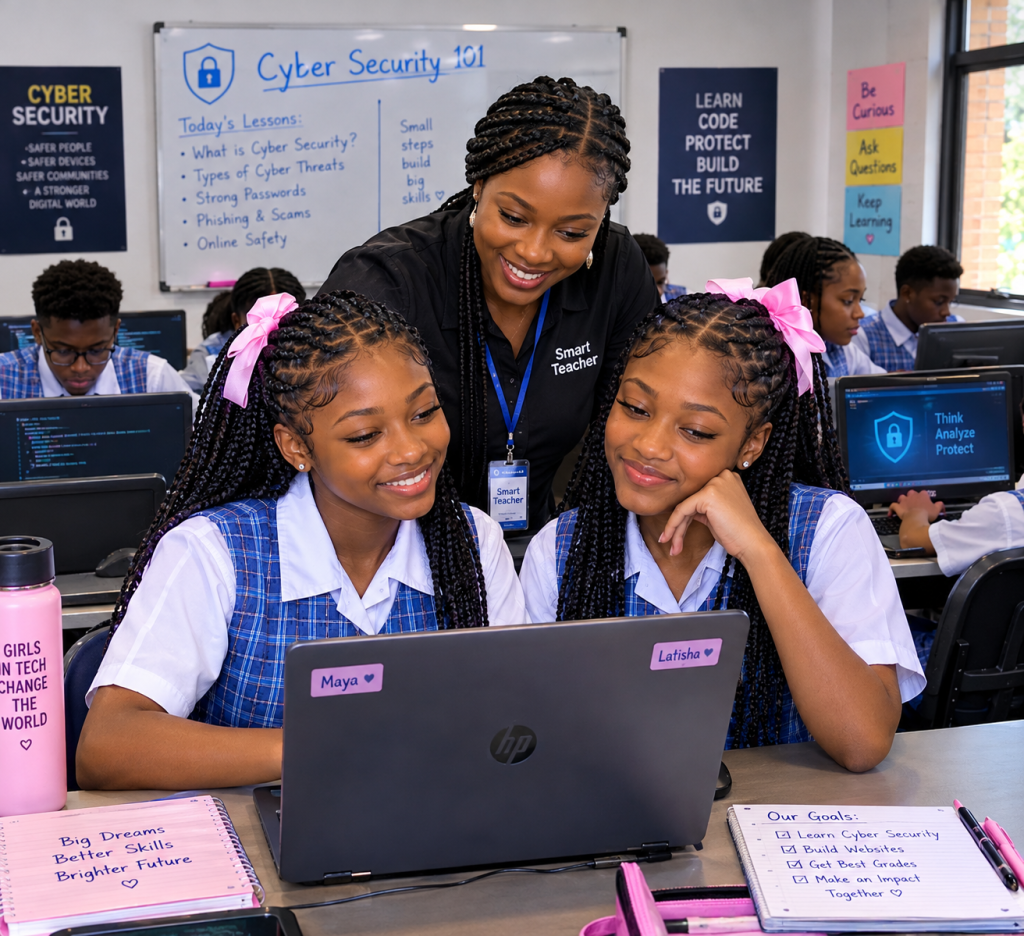
What happens when two best friends discover that their future could be bigger than they ever imagined?It was a Wednesday afternoon when Maya rushed through the front door, dropped her backpack beside the couch, and ran straight to the kitchen, where her mother was preparing dinner. “Mom! Guess what? Latisha and I are going to learn cybersecurity!” she announced, practically bouncing with excitement. Her mother turned around, raised an eyebrow, and smiled. “Cybersecurity? And what exactly do you two know about that?” Maya paused. Honestly, not much. She knew computers could be hacked, passwords could be stolen, and people sometimes lost their information online. Latisha had once told her about a video she watched explaining how hackers could break into people’s accounts.
But beyond that, the world of technology felt like a giant puzzle waiting to be solved. What Maya did know, however, was that she and Latisha were ready to learn something new. They had discovered a free introductory technology program for junior high school students that offered lessons in cybersecurity, website development, and digital literacy. And when Latisha sent Maya the registration details with the message, “Girl, imagine us becoming tech experts!” Maya knew she couldn’t pass up the opportunity.Their first class was on Saturday morning. Maya arrived ten minutes early, wearing her favourite sneakers and carrying a notebook covered in colourful stickers. Latisha was already there, sitting at a computer and trying to figure out how to navigate the learning platform.
When she spotted Maya, she waved enthusiastically. “Bestie! Please come and save me. This computer is already testing my patience!” Maya burst into laughter and pulled up a chair beside her. Their instructor, a friendly woman named Smart Teacher, welcomed the students and explained that technology wasn’t just about playing games, watching videos, or scrolling through social media. It was also about creating solutions, protecting information, and building tools that could make people’s lives better. She introduced them to cyber security, explaining how professionals worked to protect computers, networks, and personal information from digital threats. The girls learned about strong passwords, suspicious links, phishing messages, and why sharing personal information with strangers online could be dangerous.
Maya was particularly surprised when Smart Teacher demonstrated how a convincing fake message could trick someone into revealing their login details. “Wait, so somebody can pretend to be my bank and steal my information just because I click a link?” Maya asked, her eyes widening. “Exactly,” Smart Teacher replied. “That is why understanding how technology works is so important.” For the first time, Maya realized that being safe online required more than common sense. It required knowledge.
Over the next few weeks, Saturday mornings became their favourite part of the week. While other students spent their weekends sleeping late or watching cartoons, Maya and Latisha looked forward to opening their laptops and discovering something new. Their lessons became increasingly exciting. They practised identifying suspicious emails, created stronger passwords, explored how websites were built, and learned why people working in technology had to think carefully about privacy and security. Sometimes, things didn’t go according to plan. Maya once spent nearly twenty minutes trying to fix a simple mistake in a beginner coding exercise, while Latisha accidentally deleted a section of her practice webpage and stared at the screen as though the computer had personally betrayed her. “I’m done! Technology and I are no longer friends,” Latisha declared dramatically. Maya laughed so hard that their instructor had to remind them to let the other students concentrate. But after a short break, Latisha tried again, and this time, she figured it out.
That moment taught them something their instructor hadn’t written on the whiteboard: learning a technical skill wasn’t about getting everything right the first time. It was about being curious enough to ask questions, patient enough to practise, and brave enough to keep going when something seemed difficult. They began helping each other with assignments, celebrating every little achievement, and sharing what they had learned with their families. Before long, even their classmates at school started asking them questions about online safety. The girls were no longer just learning for themselves. They were beginning to use their knowledge to help others.
One Saturday, Smart Teacher announced that the students would work in pairs on a small digital safety project. Maya and Latisha immediately looked at each other. They already knew what they wanted to create: a simple online safety guide for students their age. They planned to include tips for creating secure passwords, recognizing suspicious messages, protecting personal information, and knowing what to do when something felt wrong online. Maya wanted the guide to look colourful and inviting, while Latisha insisted that every tip should be easy enough for a younger student to understand. They spent the afternoon sharing ideas, making corrections, and laughing at the silly names they came up with for their project. By the end of the session, they had a plan they were genuinely proud of.
Walking home together that afternoon, Maya turned to her best friend and said, “Do you ever think about how different our lives could be in five or ten years?” Latisha nodded. “Girl, yes! Imagine us building our own technology company or working as cybersecurity experts!” They laughed, but beneath the excitement was a realisation that neither girl had fully understood before. Their future didn’t have to be limited by what they knew today. They could learn new skills, explore unfamiliar opportunities, and gradually become the people they dreamed of being. They were still junior high school students with homework to complete, tests to prepare for, and chores waiting at home. But now, they also had a new world to explore. And they were determined to explore it together.
A little footnote for our readers 🌱💻
Dear parents, teachers, and young learners, technology is changing the world, and children deserve opportunities to understand it, shape it, and use it responsibly. You don’t have to wait until a child reaches college before introducing them to digital skills. With the right guidance, age-appropriate lessons, and room to experiment, young learners can begin developing valuable skills long before they choose a career. And to every Maya and Latisha out there: you don’t have to be a genius to start learning technology. You don’t need the most expensive laptop, and you certainly don’t need to know everything on day one.
Start with curiosity. Ask questions. Practice. Make mistakes. Try again. Because the next generation of cyber security professionals, software developers, and technology innovators might be sitting in a junior high school classroom right now, wondering what they are capable of becoming. Why not you? 💗✨
Remember: Be curious. Stay safe online. Keep learning. Your future is worth preparing for.