Skip to content

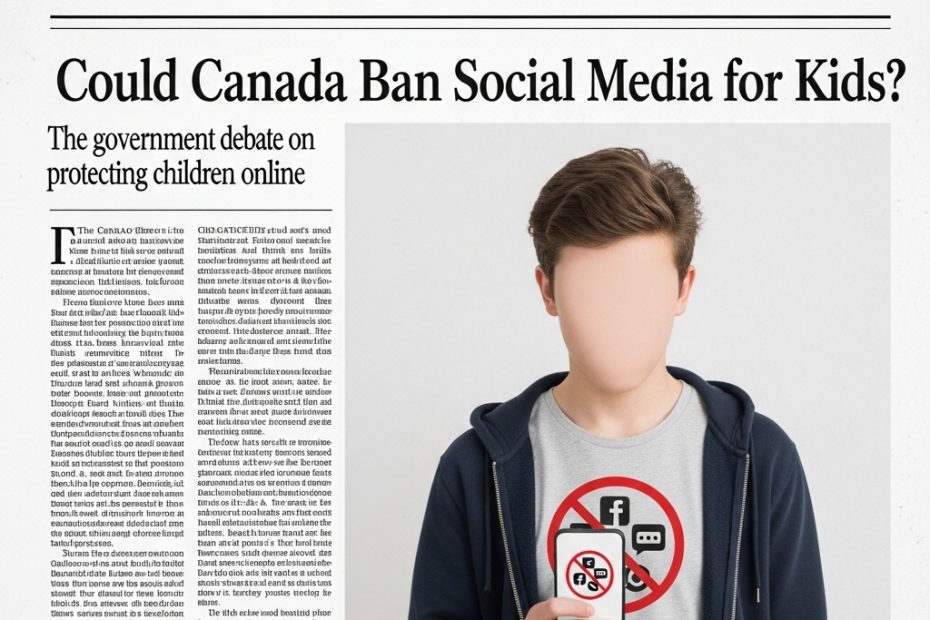
Could Canada Be the Next Country to Ban Social Media for Kids?

Social media has become a normal part of childhood for many families, but governments around the world are beginning to ask whether children are being exposed too early and at too great a cost. In Canada, this question is now at the center of a growing policy debate, as the federal government considers a possible ban on social media for children under the age of 14.

Canadian Culture Minister Marc Miller has confirmed that such a ban is being explored as part of broader online harm legislation. The move comes amid rising concern about how social media affects children’s mental health, safety, and development. From cyberbullying and online harassment to exposure to inappropriate content and addictive design features, parents and educators have long raised alarms about the risks children face online.

Canada is not alone in this conversation. Australia recently became the first country in the world to ban children under 16 from using social media platforms. That decision has sparked global discussion, with governments watching closely to see whether the policy will be effective in protecting young users. Canadian lawmakers are now examining similar approaches as they reconsider how best to safeguard children in digital spaces.

Parliament has spent several years studying online harms. Lawmakers have held multiple hearings focused on how social media platforms target young users and how easily children can be drawn into harmful online experiences. Since 2021, two versions of online safety legislation have been introduced but failed to pass. With increasing public concern and international examples to reference, the pressure to act is growing.

Technology companies, however, are pushing back against the idea of an outright ban. Many argue that enforcing age limits online is difficult, as current systems for age verification are often unreliable. Companies like Meta have suggested shifting responsibility to app stores, where Google and Apple could verify ages and require parental consent before allowing children to download social media apps.

For parents, this ongoing debate highlights an important reality. Regardless of whether a ban becomes law, children need guidance, boundaries, and education when it comes to social media use. Laws can help set limits, but they cannot replace conversations at home, parental involvement, and digital literacy.

For children, the discussion is a reminder that online spaces are not always designed with their well-being in mind. Social media platforms are built to capture attention and encourage constant engagement, which can affect self-esteem, sleep, and emotional health.

As Canada weighs its options, families are encouraged to stay informed and proactive. Understanding the risks, setting clear rules, and maintaining open communication can help children navigate the online world more safely, regardless of what legislation is eventually passed.

CYBERBULLYING and it’s effects on young people.

Cyberbullying has changed the way bullying affects young people. In the past, bullying often ended when a child left school. Today, it can follow them home through phones, social media, and messaging apps, making it almost impossible to escape. The emotional damage caused by cyberbullying can be severe, especially when it goes unnoticed for long periods.

Sophie was just 14 when her teacher, Ethan, noticed something was wrong. She had become withdrawn in class, avoided her phone, and seemed distracted and uninterested in her schoolwork. These changes may not seem alarming on their own, but together they formed a pattern that Ethan recognized as a sign of distress.

Like many teenagers, Sophie found it hard to talk about what she was going through. Fear and embarrassment kept her silent. When Ethan involved her parents, they slowly learned that Sophie was being bullied by her peers, both at school and online.

What made Sophie a target was something many children experience. She wore glasses because of myopia. For years, it had not mattered. Then suddenly, classmates began mocking her appearance. The teasing spread quickly and turned cruel. Sophie lost friends and became isolated, labeled as “different.”

The bullying became far more dangerous when it moved online. Former friends created a fake social media group designed to humiliate her. The group grew rapidly, and Sophie was tagged in hateful posts and sent abusive messages. She was threatened with the exposure of private messages and false rumors if she spoke out. The bullying continued for months, silently damaging her mental health.

By the time adults intervened, Sophie had begun self-harming. This moment highlighted how deeply cyberbullying can affect a young person when it is hidden and unresolved. With support from her teacher and parents, the fake accounts were reported, the bullying stopped, and steps were taken to prevent it from happening again.

Today, Sophie is confident, resilient, and preparing for college. Her story reminds us that cyberbullying is serious, but it is not unstoppable. Early attention, open communication, and teamwork between parents, teachers, and schools can protect children and help them heal.

BEFORE GETTING THAT GADGET FOR YOUR TEENAGER, CONSIDER THESE FIRST!

The moment a parent hands a teenager their first serious gadget often feels bigger than it looks. It is not just a phone or a laptop. It is a quiet transition. A step toward independence. A signal of trust. For many families, this moment comes with excitement, hesitation, and a long list of questions that rarely have simple answers.

Teenagers today live in a world where technology is everywhere. School assignments are submitted online. Friendships are maintained through messages and social platforms. Information is available at the tap of a screen. It is no surprise that many parents feel pressure to buy devices earlier than they planned, especially when everyone around them seems to be doing the same. But giving a teenager a gadget is not a decision to rush. It deserves thought, conversation, and clarity.

Before any device changes hands, one question matters more than the brand or the model. Is this teenager ready? Readiness has very little to do with age and everything to do with maturity. Some teenagers can manage screen time, respect boundaries, and communicate openly about what they encounter online. Others may still struggle with impulse control or emotional regulation. A device connected to the internet opens doors to learning and creativity, but it also opens doors to content, conversations, and pressures that can be overwhelming without guidance.

Many parents underestimate how quickly a gadget becomes part of a teenager’s emotional world. It can shift routines, affect sleep, change attention spans, and influence self-esteem. Once exposure begins, it is difficult to reverse. That is why it is important for parents to slow down and consider not just what their teenager wants, but what they truly need at this stage of development.

Clear rules are another part of the conversation that cannot be skipped. Devices without boundaries often create confusion and conflict. Teenagers need structure, even when they push against it. Talking openly about screen time, online safety, social media behavior, and consequences builds trust and prevents misunderstandings. When expectations are clear from the beginning, teenagers are more likely to use their devices responsibly.

Parental involvement does not end once the device is handed over. Monitoring, guidance, and regular check-ins are essential. This is not about control or surveillance. It is about protection and partnership. Teenagers are learning how to navigate a digital world that even adults are still figuring out. They need support, not silence.

Finally, gadgets can be powerful tools for building responsibility when used intentionally. Involving teenagers in decisions about data usage, care of the device, and balanced routines teaches accountability. Encouraging offline activities, face-to-face relationships, and downtime reminds them that technology is a tool, not a replacement for real life.

Giving a teenager a gadget is not just a purchase. It is a parenting decision that shapes habits, values, and trust. When handled thoughtfully, it can become a positive step forward rather than a source of regret.

Microsoft Uncovers ‘Whisper Leak’ Attack That Can Identify Chat Topics in Encrypted AI Conversations.

Artificial intelligence tools like ChatGPT have become a regular part of modern life, helping students with assignments, parents with planning, and professionals with their work. But new research from Microsoft has revealed that even encrypted conversations with these AI tools may not be completely private. The company’s cybersecurity team recently uncovered a new type of cyberattack called Whisper Leak, which can allow attackers to guess what people are discussing with AI chatbots by analyzing encrypted traffic patterns.
At first glance, this sounds impossible. After all, encrypted chats are supposed to be secure. However, Microsoft researchers discovered that while attackers cannot read the exact words exchanged, they can still analyze the size and timing of the data packets moving between the user and the chatbot. By studying these patterns, attackers can train systems to predict when someone is talking about certain topics, such as politics, financial crimes, or other sensitive matters. It’s similar to listening to a conversation without hearing the words but still figuring out the subject from the rhythm and tone.
This vulnerability targets something called model streaming, a feature that allows AI chatbots to respond gradually as they generate answers. While this makes responses appear faster and more natural, it also gives attackers more data to analyze. Microsoft’s proof-of-concept testing showed that trained machine learning models could predict the topics of encrypted AI conversations with accuracy rates above 98 percent. Many popular models, including those from Microsoft, OpenAI, Mistral, Alibaba, and xAI, were affected. Google and Amazon models were slightly more resistant but still not immune.
The danger grows over time. The more data an attacker collects, the more accurate their systems become, turning Whisper Leak into a realistic and ongoing privacy risk. Microsoft warned that anyone with access to network traffic, such as someone sharing your Wi-Fi or even an internet service provider, could potentially use this method to track what you discuss with an AI assistant.
To counter this, major AI companies have started implementing fixes. One approach is to randomize the length of chatbot responses, making it harder to detect patterns. Microsoft also recommends that users avoid discussing highly sensitive topics when connected to public Wi-Fi, use VPNs for extra protection, and choose non-streaming chatbot options when privacy is essential.
For families, this discovery reinforces the importance of digital awareness. Parents and children need to understand that while AI tools are useful, they are not completely private. Kids should be encouraged to avoid sharing personal or sensitive information in chats. For professionals, it’s a reminder that confidential work-related topics should not be discussed through AI chatbots unless the platform has strict privacy controls.
The Whisper Leak attack is a wake-up call about the hidden risks of AI communication. It doesn’t mean we should stop using AI, it means we must use it wisely and stay alert.
Stay Smart. Stay Secure. Stay Cyber-Aware. Follow us on Instagram @smartteacheronline for practical, family-friendly cyber tips and weekly updates.

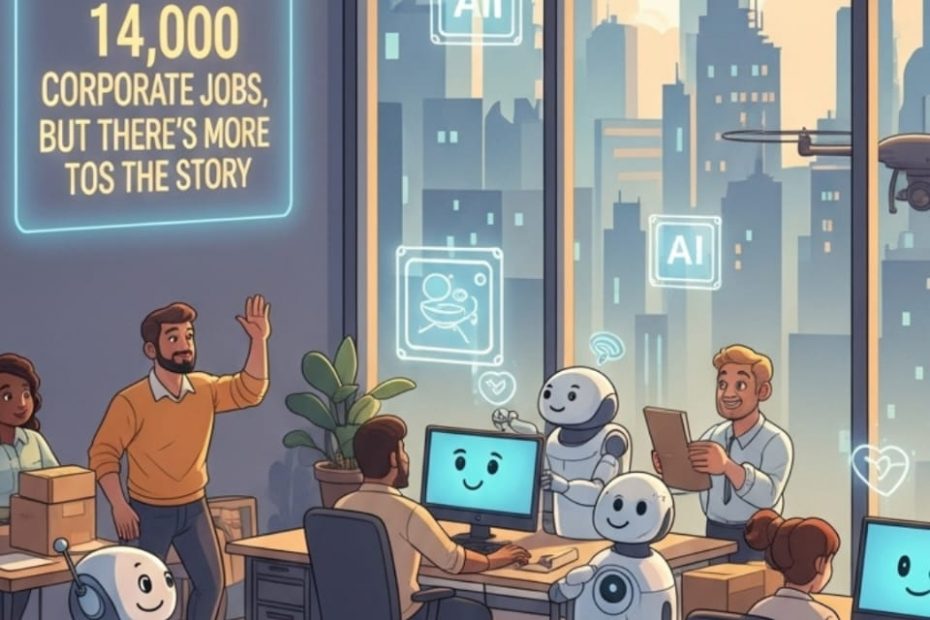
Amazon Says Goodbye to 14,000 Corporate Jobs, but There’s More to the Story.

It’s the first week of November, and while most of us are settling into the calm rhythm of a new month, something big is stirring inside one of the world’s largest companies.
Amazon, yes, the same company that delivers your favorite books, gadgets, and late-night snack orders—is saying goodbye to 14,000 corporate workers. But before you panic or picture a sad parade of cardboard boxes and teary farewells, here’s the twist: Amazon isn’t collapsing. It’s transforming.
In a heartfelt note to staff, Beth Galetti, a senior vice president at the tech giant, explained that the company wants to become leaner, faster, and sharper. She said Amazon is reorganizing so it can take full advantage of the most powerful tool shaping our time, Artificial Intelligence.
AI, Galetti explained, is not just a buzzword. It’s the modern version of electricity, changing how every part of business and daily life works. From the way we shop to how we communicate, it’s already everywhere. And for Amazon, a company built on innovation, staying ahead means trimming unnecessary layers and investing in what truly matters.
It’s a bold move. After all, this announcement comes just months after Amazon reported an eye-popping $167 billion in quarterly sales, beating expectations across Wall Street. The company isn’t losing money, it’s re-shaping how it makes money.
For many workers, the news is bittersweet. Some will be offered new opportunities within Amazon. Others will receive support to transition into new careers. And while job cuts never come easy, Amazon insists this moment is about evolution, not elimination.
As CEO Andy Jassy shared earlier this year, “AI will mean fewer people doing some jobs, but more people doing new kinds of work.” That’s the delicate balance of progress, the same technology that automates one task creates an entirely new field in another.
Industry experts say the layoffs reflect a wider truth: companies everywhere are rewriting the playbook. Automation and AI are changing the workforce at lightning speed, and even tech giants aren’t immune to reinvention.
For us at Smart Teacher, this story isn’t just about corporate restructuring, it’s about learning to adapt. Whether you’re a student discovering coding, a parent guiding your child through career choices, or a professional curious about AI’s impact on work, the message is clear: the future belongs to the adaptable.
Because when technology moves fast, standing still isn’t safe, it’s standing still that makes you obsolete.
So, Smart Learners, as November unfolds, remember this: every shift in the world of work is also a signal for us to upgrade our own skills, our mindset, and our curiosity. Because the smartest companies, and the smartest people, never stop learning.

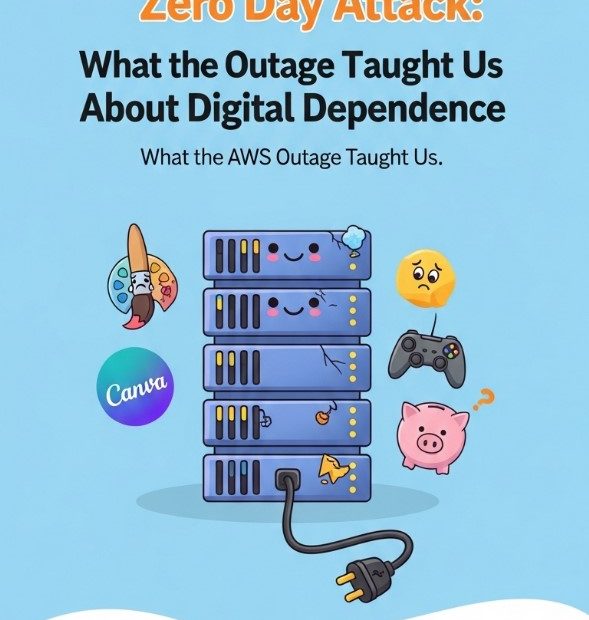
When the Internet Crashes: What the AWS Outage Taught Us About Online Dependence

It’s easy to think of the internet as this untouchable, ever-present force, but the truth is far more fragile. Most of what we do online, streaming, learning, gaming, communicating runs on invisible systems powered by companies like Amazon, Google, and Microsoft. In fact, these three control more than 60% of the global cloud infrastructure. So when one of them goes down, it’s not just a glitch, it’s a global event.

For a few hours, millions of people couldn’t work, play, or communicate as usual. Businesses lost transactions. Creators couldn’t access their files. Even financial platforms like PayPal’s Venmo and Chime faced disruptions. It was a reminder that the cloud, though powerful, isn’t infallible.

But here’s the silver lining: events like these open our eyes to the reality of digital dependency and why cyber awareness matters more than ever. Being cyber-aware isn’t just about avoiding scams or setting strong passwords; it’s about understanding the systems we rely on and preparing for moments when technology fails.

At Smart Teacher Platform, we believe every parent, student, and professional should understand the basics of digital safety and resilience. That starts with simple but powerful steps, knowing where your data lives, keeping backups, and protecting your online identity with strong, unique passwords and two-factor authentication (2FA). Because while we can’t control when a tech giant has a bad day, we can control how prepared we are when it happens.

This wasn’t just a tech story. It was a life lesson in digital awareness, one that affects us all, from classrooms to boardrooms, from designers to gamers. The more we understand the systems that shape our world, the better we can navigate them safely, smartly, and securely.

Comparison is a thief of joy!

Sometimes as parents, we feel tempted to compare our children with others—especially when it seems like they aren’t reaching milestones as quickly as we think they should. But the truth is, comparison only breeds frustration. It doesn’t help us, and it certainly doesn’t help our children. Instead, let’s choose to appreciate their uniqueness. Every child blooms at their own pace, in their own way. When we celebrate their progress no matter how small we give them the motivation to keep…