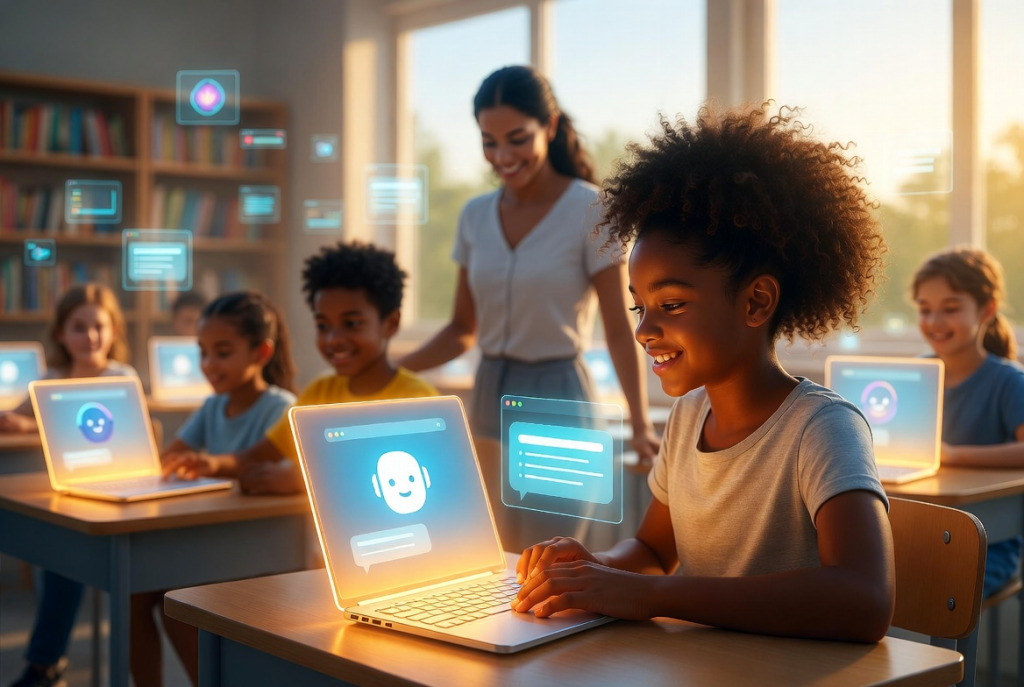
The most exciting shift in education since the invention of the blackboard
It’s 10:30 PM on a Tuesday in Lagos. Twelve-year-old Amara stares at a fractions problem that’s had her in tears for nearly an hour. She’s reread the textbook and watched YouTube videos, but nothing clicks. Her teacher isn’t available until morning, and her parents can’t explain mixed-number division.
Then, Amara opens her laptop and asks her AI tutor for help.
Instead of giving the answer, the AI responds with a question: “If I had half a pizza and wanted to share it equally among three friends, how many pieces would each person get?”
Amara smiles. Over the next 20 minutes, through patient conversation, hints, and encouragement, the AI guides her until she truly understands fractions. This isn’t science fiction — it’s happening right now.
The Persistent Problem: One Teacher, Thirty Students
For centuries, classrooms have followed the same model: one teacher at the front, students in rows, all expected to learn at the same pace. Some students get bored; others fall behind. Teachers, no matter how dedicated, simply can’t give every child individual attention.
Education psychologist Benjamin Bloom’s landmark 1984 study showed that students with one-on-one tutoring performed two standard deviations better than those in traditional classrooms. The barrier has always been cost — private tutors are out of reach for most families, widening educational inequality.
Artificial intelligence is changing that. For the first time, every child — whether in London, Lagos, a wealthy suburb, or a rural village — can access a personal tutor that never tires, never frustrates, and explains concepts in as many ways as needed.
What Is an AI Tutor?
An AI tutor isn’t a robot lecturing from the front of the class. It’s a smart, patient digital assistant that engages in conversation. The best ones use the Socratic method — asking guiding questions so students discover answers themselves, building deeper understanding.
Popular AI Tutors Making an Impact:
- Khanmigo (by Khan Academy): Uses Socratic dialogue instead of giving direct answers. Available in 266 U.S. school districts and costs just $4/month for families.
- Socratic by Google: Allows students snap a photo of homework for step-by-step explanations.
- Buddy.ai: Helps young children practice English through voice interaction.
- RORI and TARI (Rising Academies): Supports literacy and numeracy in low-resource schools in places like Sierra Leone.
The Evidence Is Compelling
Data backs the excitement:
- 85% of teachers used AI in the classroom during the 2024-2025 school year.
- The global AI education market is projected to reach $112 billion by 2034.
- A 2025 randomized controlled trial in Scientific Reports found students using AI tutors learned more in less time and felt more engaged.
- Khan Academy data shows students mastering 60 extra skills per year can double their annual academic gains on standardized tests.
A Day in the AI-Powered Classroom
At Alpha School in Austin, Texas, students finish core academics (math, reading, science, history) in just two hours thanks to personalized AI tutoring. The rest of the day focuses on collaboration, creativity, arts, and physical activity. Teachers act as mentors rather than lecturers.
In Hobart, Indiana, high school student Austin uses Khanmigo for a chemistry question. The AI guides him through dialogue, while his teacher uses a dashboard to see exactly which students need help and who’s ready for advanced work.
Benefits for Children
- Infinite Patience: AI never sighs or moves on. It explains the same concept 50 different ways if needed — ideal for students with ADHD, dyslexia, anxiety, or different learning styles.
- Personalized Pace: Fast learners advance quickly; others get extra time without pressure.
- 24/7 Availability: Help is there at midnight or on weekends.
- Builds Real Understanding: Well-designed tutors like Khanmigo refuse to just give answers, promoting genuine learning through productive struggle.
Benefits for Teachers
AI doesn’t replace teachers — it liberates them. Routine tasks like lesson planning, grading, and basic explanations shift to AI, freeing teachers to focus on mentoring, emotional support, creativity, and building relationships.
Teachers gain real-time dashboards showing exactly where each student struggles, allowing targeted human intervention.
Addressing the Concerns
We must be thoughtful of the following:
- Digital Divide: Not every child has devices or reliable internet, especially in low-income or rural areas. Efforts are underway for offline and low-bandwidth solutions.
- Human Connection: AI can’t replace the empathy and belief a caring teacher provides.
- Privacy: Strong protections are essential for student data.
- Productive Struggle: AI should guide without removing the valuable frustration of wrestling with hard problems.
The Road Ahead
In 2026, AI tutoring is moving from pilots to standard practice. By 2034, adaptive AI learning is expected to be built into most education platforms.
The dream, as Sal Khan of Khan Academy puts it, is a personal AI tutor for every child on Earth — including those in rural Nigeria, Indonesian villages, and South African townships.
AI tutors amplify the joy of learning by removing barriers of pace, embarrassment, and availability. They don’t replace human teachers or the magic of education — they enhance both, creating classrooms that are more personalized, engaging, and human.
For parents: A patient guide is always available when you can’t help. For children: Someone who meets them exactly where they are and believes they can learn anything. For teachers: More time for what matters most — inspiring and connecting with students.
The classroom of the future grows with every child, lesson by lesson.
Educating the future, one smart lesson at a time.
Smart Teacher • 2026